Automated Systems
AUTOMATED TEST SYSTEMS
AUTOMATED TEST SYSTEMS
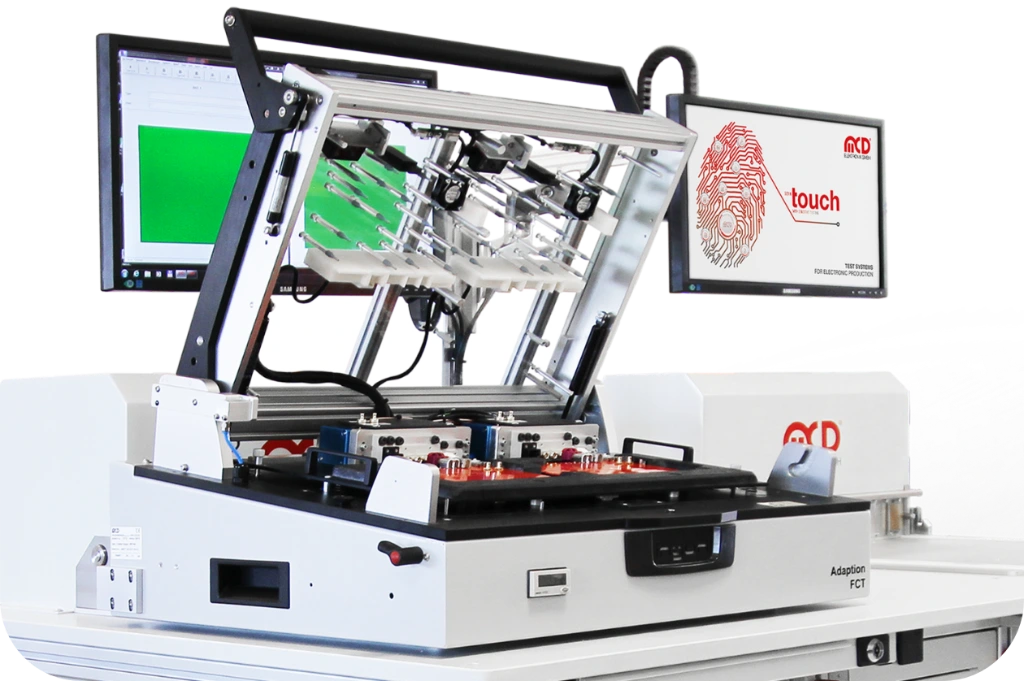
Automated test systems execute test sequences according to defined specifications, thereby reducing manual influences in the testing process. Depending on the application, individual process steps or the entire test sequence can be automated.

Blinker, Kamera, Heizung und Assistenzsysteme.
Automated Systems
Außenspiegel
AUTOMATED TEST SYSTEMS
The device under test is loaded, positioned, connected, stimulated, measured and evaluated. Depending on the system, automation also handles clamping, handling, measurement data acquisition, result evaluation and documentation.
MCD Elektronik develops automated test systems tailored to the device under test, the process, the degree of automation and quality requirements—from test concept to on-site commissioning.
Ein flexibler End-of-Line-Prüfstand
MCD entwickelte hierfür einen flexiblen End-of-Line-Prüfstand, der sämtliche Varianten innerhalb von weniger als 30 Sekunden prüft. Das System kombiniert optische, mechanische und elektrische Prüfverfahren zu einem durchgängigen Prüfkonzept.
Produktvarianten
Produktvarianten
Über 30
- Taktzeit pro Bauteil
- Taktzeit pro Bauteil
Unter 30 s
Qualitätskontrolle vor Auslieferung
Qualitätskontrolle vor Auslieferung
100 %
Produktvarianten
Produktvarianten
Über 30
- Taktzeit pro Bauteil
- Taktzeit pro Bauteil
Qualitätskontrolle vor Auslieferung
Qualitätskontrolle vor Auslieferung
100 %
Automated test systems combine testing and process steps into defined workflows. Depending on the application, functional tests, electrical measurements, communication tests, RF tests, optical inspections, as well as programming and documentation processes can be integrated.
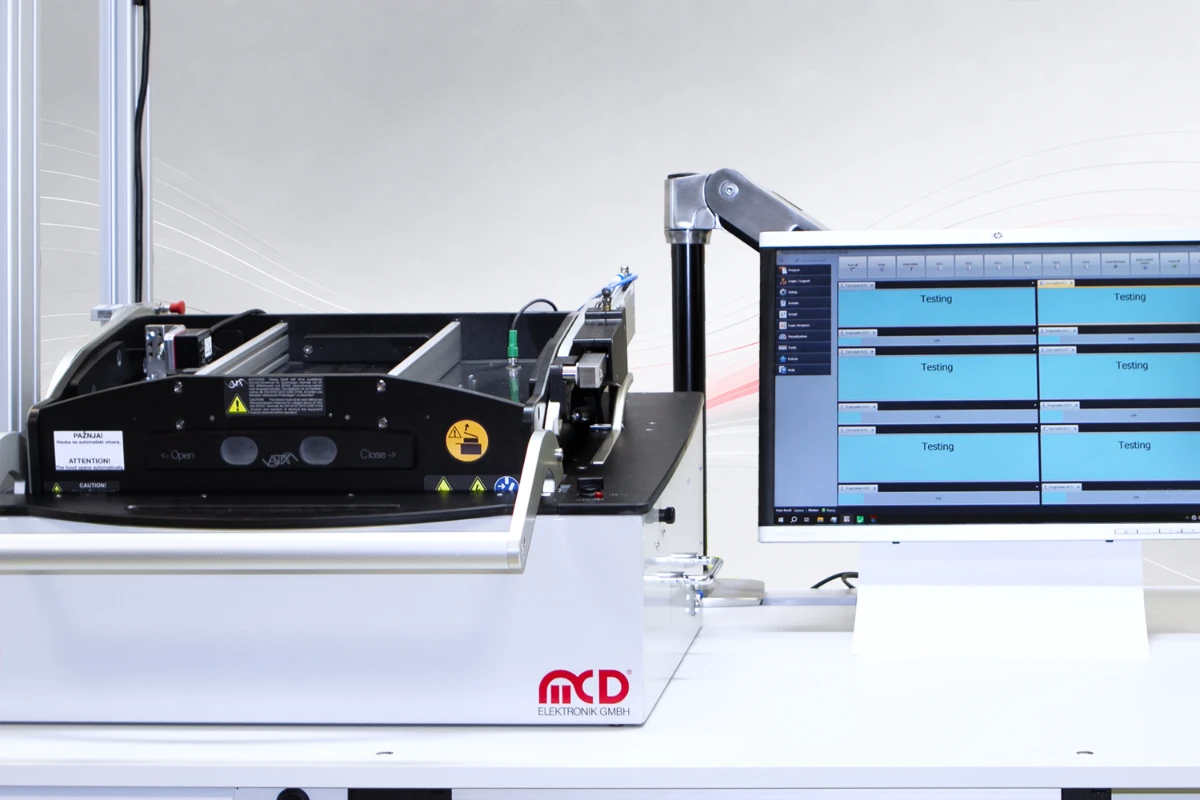


The test process can range from individual automated work steps to a fully automated sequence.
- Loading and positioning the device under test
- Contacting and locking
- Stimulation and measurement data acquisition
- Automatic result evaluation
Electronic assemblies are tested under defined conditions, and relevant electrical and functional parameters are evaluated automatically.
- Functional and end-of-line tests
- Current and voltage measurements
- Signal and communication testing
- Pin checks
Depending on the application, additional test methods and production-related process steps can be integrated into the automated test system.
- RF testing
- Optical inspections
- Leak and load testing
- Flash programming and configuration
- Label printing
In addition to testing, automated workflows can also handle part handling, sorting and digital test result documentation.
- Automated handling
- Pass/fail sorting
- Digital test result documentation
- Data integration and traceability
Einblick in die MCD Prüflösung
Variantenspezifische Prüflogik
Der Prüfstand überprüft sämtliche vorhandenen Funktionen des Außenspiegels:
Spiegeleinstellungen
Kamerasysteme kontrollieren Lichtfunktionen und Spiegelstellungen, während Antriebe, Klappmechanismen und elektrische Funktionen automatisiert getestet werden.
Verstell- und Klappfunktion
Spiegelheizung
EC-Abblendglas
Lichtfunktionen
Blinker
Spurwechselassistent
Umfeldbeleuchtung
Kamerafunktion
Unterschiedliche Ausstattungsmerkmale werden automatisch erkannt und gezielt geprüft.
Kamerafunktion
Länderspezifische Varianten
Auch das Nichtvorhandene zählt.
Die Negativprüfung stellt sicher, dass sich nicht verbaute Ausstattungsmerkmale nicht aktivieren lassen. Geprüft wird auch, was fehlen muss.

Automated test systems can be configured in many ways: as a semi-automated test station, automated adapter station, rotary indexing table system, robot cell, validation station or combined assembly and test system.
The focus of automated test systems is on automating the test process itself. Mechanics, adaptation, measurement technology, software, safety, the operating concept and data integration are combined into a stable, scalable and maintainable overall system.
Prüfung komplexer Ausstattungsvarianten
Sichere Erkennung von Fehlerbildern
Reproduzierbare Ergebnisse
Optische Prüfungen
Kamerabasierte Erkennung von Lichtfunktionen
Analyse von Spiegelstellungen
Kontrolle des Spiegelglases
Mechanische und elektrische Prüfungen
Bewegungsprüfung der Antriebe
Winkelmessung der Klappfunktion
Stromaufnahme der Motoren
Prüfung komplexer Ausstattungsvarianten
Sichere Erkennung von Fehlerbildern
Reproduzierbare Ergebnisse
AUTOMATED TESTING
AUTOMATED TESTING

Automated test systems execute test sequences according to defined specifications, thereby reducing manual intervention in the testing process. The test object is loaded, positioned, connected, stimulated, measured, and evaluated. Depending on the system, the automation handles individual steps or the entire test sequence, including clamping, handling, measurement data acquisition, result evaluation, and documentation.
Unlike a purely manual test station, an automated test system ensures high repeatability, consistent cycle times, and traceable test results. It is particularly well-suited for recurring test tasks, increasing production volumes, complex measurement sequences, or high requirements for quality and traceability.
MCD Elektronik does not develop such systems as off-the-shelf solutions, but rather tailors them to the test object, process, degree of automation, and quality requirements—from test design through on-site commissioning.
TYPICAL TESTING METHODS AND CONCEPTS
TYPICAL TESTING METHODS AND CONCEPTS

Automatisierte Testsysteme können sehr unterschiedlich ausgelegt sein: als halbautomatische Prüfstation, automatisierter Adapterplatz, Rundschalttischsystem, Roboterzelle, Validierungsstation oder kombinierte Montage- und Prüfanlage.
Entscheidend ist dabei nicht, ob das System in einer Fertigungslinie steht, sondern welche Prüf- und Prozessschritte automatisiert ablaufen. Während ein Inline-Testsystem per Fördertechnik oder Handlingsysteme direkt in den laufenden Produktionsfluss eingebunden ist, kann ein automatisiertes Testsystem dagegen auch als eigenständige Station, Roboterzelle, Rundschalttisch oder halbautomatischer Prüfplatz außerhalb einer Linie arbeiten. Der Schwerpunkt liegt hierbei auf der Automatisierung des Prüfprozesses selbst.
Typische Prüfaufgaben umfassen Funktions- und End-of-Line-Tests elektronischer Baugruppen. Dazu gehören Strom- und Spannungsmessungen, Signal- und Kommunikationsprüfungen, HF-Tests, optische Inspektionen, Pin-Checks, Dichtheits- und Belastungsprüfungen, Flash- und Programmierprozesse, Labeldruck, Pass/Fail-Sortierung sowie die digitale Ergebnisdokumentation.
Für MCD steht dabei das Gesamtsystem im Fokus: Mechanik, Adaption, Messtechnik, Software, Sicherheit, Bedienkonzept und Datenanbindung werden so kombiniert, dass ein stabiler, skalierbarer und wartbarer Prüfprozess entsteht.
Test methods and concepts used
Test methods and concepts used

Procedure
Automated Systems
INSERT
POSITIONING
STIMULUS & MEASUREMENT
DIAGNOSIS & RESPONSE
RESULTS & TRACEABILITY
FREQUENTLY ASKED QUESTIONS
FAQS