EOLT Systems
End-of-Line Test Systems

End-of-Line Test Systems
End-of-line tests are the final quality check of a product at the end of production. All relevant functions, interfaces and quality characteristics must be reliably tested against defined specifications.

Blinker, Kamera, Heizung und Assistenzsysteme.
EOLT Systems
Außenspiegel
End-of-Line Test Systems
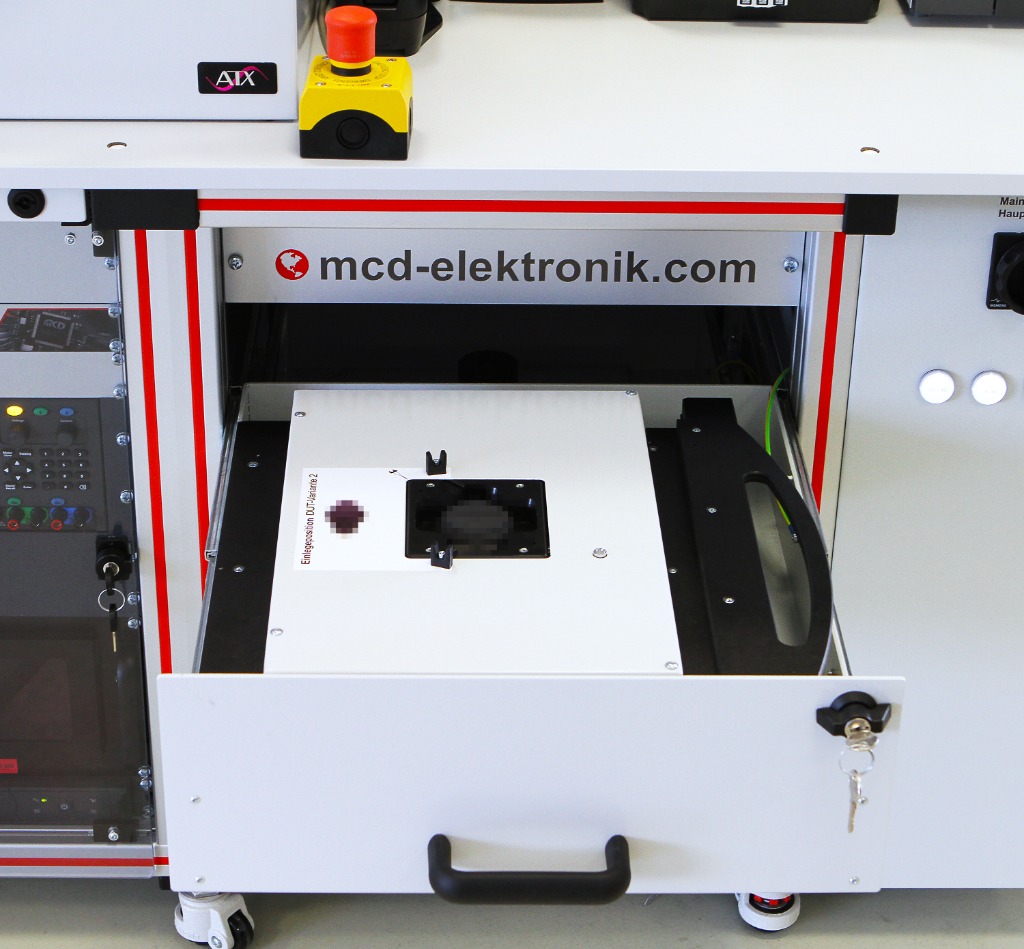
EOL test stands are used directly at the end of an assembly or production line. Depending on the product, cycle time, test requirements and level of automation, they can be designed as manual test stations, semi-automatic stations, rotary indexing tables, robot-assisted test cells or fully integrated line solutions.
EOL tests help to identify defective products before delivery, reduce returns and ensure consistently high product quality. At the same time, they provide documented measurement results for traceability, series release and process optimization.
Ein flexibler End-of-Line-Prüfstand
MCD entwickelte hierfür einen flexiblen End-of-Line-Prüfstand, der sämtliche Varianten innerhalb von weniger als 30 Sekunden prüft. Das System kombiniert optische, mechanische und elektrische Prüfverfahren zu einem durchgängigen Prüfkonzept.
Produktvarianten
Produktvarianten
Über 30
- Taktzeit pro Bauteil
- Taktzeit pro Bauteil
Unter 30 s
Qualitätskontrolle vor Auslieferung
Qualitätskontrolle vor Auslieferung
100 %
Produktvarianten
Produktvarianten
Über 30
- Taktzeit pro Bauteil
- Taktzeit pro Bauteil
Qualitätskontrolle vor Auslieferung
Qualitätskontrolle vor Auslieferung
100 %
EOL test systems cover different test tasks depending on the application. Electronics, communication, radio frequency, mechanics, haptics, optics, as well as programming and parameterization can be combined within a tailored test concept.


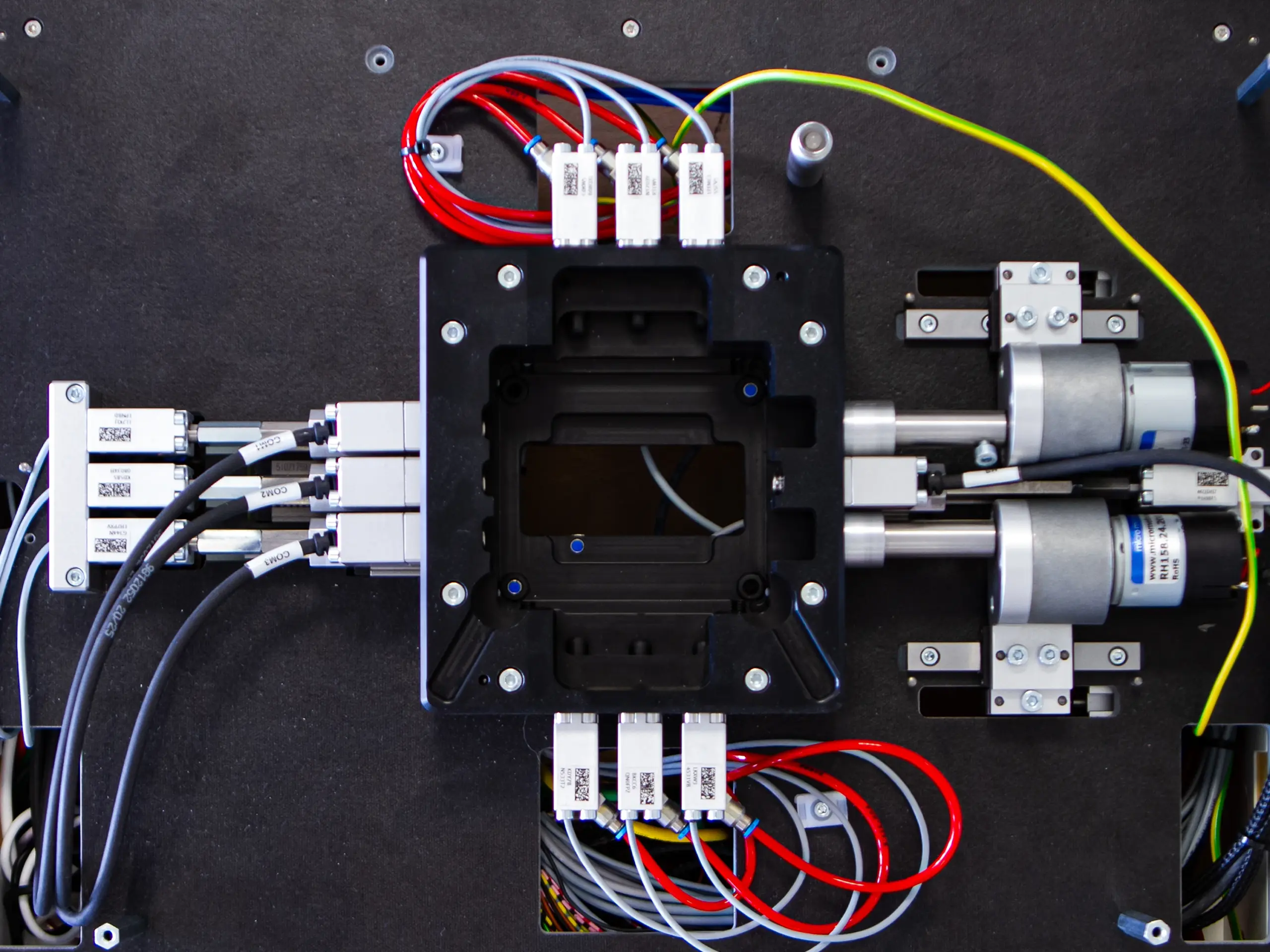
Electronic assemblies are functionally tested and relevant electrical parameters are recorded automatically.
- Functional tests of electronic assemblies
- Current measurements
- Voltage measurements
- Load and safety tests
Interfaces, signals and communication functions can be tested and evaluated in a targeted way.
- Signal tests
- Communication tests
- Testing of relevant interfaces
- Documentation of measurement results
Depending on the product, additional test methods for radio modules as well as mechanical, haptic and optical properties can be integrated.
- RF tests for antenna modules
- RF tests for transmitter and receiver modules
- Mechanical tests
- Haptic tests
- Optical tests
In addition to the actual quality test, control units can be programmed and parameterized within the EOL process.
- Programming of control units
- Parameterization of control units
- Series release based on test results
- Connection to databases or higher-level systems

Einblick in die MCD Prüflösung
Variantenspezifische Prüflogik
Der Prüfstand überprüft sämtliche vorhandenen Funktionen des Außenspiegels:
Spiegeleinstellungen
Kamerasysteme kontrollieren Lichtfunktionen und Spiegelstellungen, während Antriebe, Klappmechanismen und elektrische Funktionen automatisiert getestet werden.
Verstell- und Klappfunktion
Spiegelheizung
EC-Abblendglas
Lichtfunktionen
Blinker
Spurwechselassistent
Umfeldbeleuchtung
Kamerafunktion
Unterschiedliche Ausstattungsmerkmale werden automatisch erkannt und gezielt geprüft.
Kamerafunktion
Länderspezifische Varianten
Auch das Nichtvorhandene zählt.
Die Negativprüfung stellt sicher, dass sich nicht verbaute Ausstattungsmerkmale nicht aktivieren lassen. Geprüft wird auch, was fehlen muss.

For complete quality assurance and traceability, measurement results are documented and analyzed. If required, the EOL test system can be connected to databases or higher-level systems.
EOL tests are designed to match the product, cycle time, test requirements and level of automation. Different test methods and system concepts can be combined into a continuous end-of-line solution.
Prüfung komplexer Ausstattungsvarianten
Sichere Erkennung von Fehlerbildern
Reproduzierbare Ergebnisse
Optische Prüfungen
Kamerabasierte Erkennung von Lichtfunktionen
Analyse von Spiegelstellungen
Kontrolle des Spiegelglases
Mechanische und elektrische Prüfungen
Bewegungsprüfung der Antriebe
Winkelmessung der Klappfunktion
Stromaufnahme der Motoren
Prüfung komplexer Ausstattungsvarianten
Sichere Erkennung von Fehlerbildern
Reproduzierbare Ergebnisse
End-of-Line Tests
End-of-Line Tests

An end-of-line test, or EOL test for short, is the final quality inspection of a product at the end of the manufacturing process. It verifies whether all relevant functions, interfaces, and quality characteristics meet the defined specifications. EOL test stations are deployed directly at the end of an assembly or manufacturing line and can be semi-automatic, fully automatic, or integrated into existing production lines.
EOL tests help identify defective products before shipment, reduce returns, and ensure consistently high product quality. At the same time, they provide documented measurement results for traceability, series approval, and process optimization.
Typical Test Methods and Concepts
Typical Test Methods and Concepts

EOL tests can vary greatly depending on the product, cycle time, test requirements, and degree of automation. To address this, customized EOL concepts are developed, ranging from manual test stations to semi-automatic stations and rotary indexing tables, all the way to robot-assisted test cells or fully integrated line solutions.
Typical test tasks include functional tests of electronic assemblies, current and voltage measurements, as well as signal and communication tests. RF tests for antenna, radio, and receiver modules, mechanical, haptic, and optical tests, as well as the programming and parameterization of control units, can also be part of the testing process. Additionally, leak, stress, or safety tests can be integrated.
To ensure comprehensive quality assurance and traceability, the measurement results are documented and evaluated, and, if necessary, the EOL test system is connected to databases or higher-level systems.
Test methods and concepts used
Test methods and concepts used

Procedure
EOLT Systems
Insert
Contact / Shield
Stimulus & Measurement
Diagnostics & Logging
RESULTS & TRACEABILITY
FREQUENTLY ASKED QUESTIONS
FAQS