MCD VTS 2030-RACKSYSTEME
STANDARDS AND MODULARITY IN TEST SYSTEM CONSTRUCTION
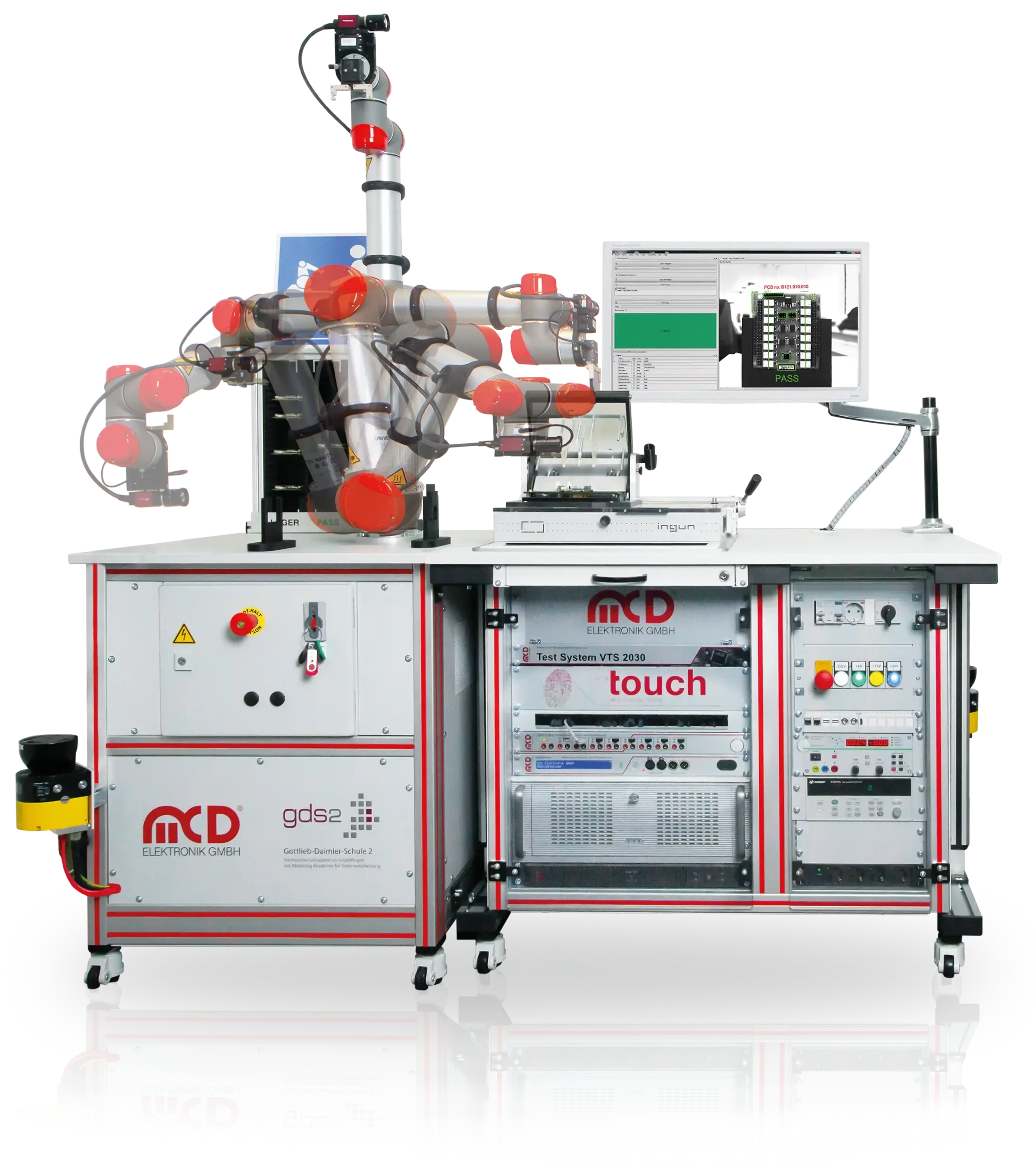
Standardized test system basis for flexible testing tasks
The MCD VTS 2030 combines standardized and reusable system components with the flexibility of a customer-specific testing solution. Test adapters, measurement modules, software processes and automation can be specifically adapted to different test objects and test tasks.

Turn signals, cameras, heating and driver assistance systems.
Exterior mirrors
STANDARDS AND MODULARITY IN TEST SYSTEM CONSTRUCTION
The focus is on the MCD VTS rack as the mechanical and technical basis of the system. It can be equipped with PC, height adjustment systems, RFID modules, relay multiplexer cards and customized hardware components such as cobots or HV adapters.
The test adapter with the holder for the test object is located on the table or system surface. Additional adapters can be retrofitted for additional test items without rebuilding the entire test system.
A flexible end-of-line test bench
For this application, MCD developed a flexible end-of-line test bench that tests every variant in less than 30 seconds. The system combines optical, mechanical and electrical test methods in one integrated testing concept.
Product variants
Product variants
More than 30
- Cycle time per part
- Cycle time per part
Under 30 s
Quality inspection before delivery
Quality inspection before delivery
100 %
Product variants
Product variants
More than 30
- Cycle time per part
- Cycle time per part
Quality inspection before delivery
Quality inspection before delivery
100 %
Standardized & modular
The VTS 2030 combines a standardized rack base with flexibly configurable test adapters, interfaces, hardware components and software tools. This means that the system can be adapted to different testing tasks and expanded to meet new requirements.


The MCD VTS Rack forms the mechanical and technical basis and can be equipped with additional components depending on the application.
- PC integration
- Height adjustment systems
- RFID modules and relay multiplexer cards
- Customer-specific hardware such as cobots or HV adapters
The pylon interface connects the test adapter and test system and enables quick, safe docking and the changing of different test adapters.
- Interchangeable test adapters
- Fast and safe docking
- Retrofitting additional adapters
- Reuse of the existing system base
Depending on the application, various interface blocks can be integrated into the system.
- Electrical signals
- Light guides and pneumatics
- High current and high frequency
- Other special requirements
- MCD TestMate and MCD TestManager
- MCD Comet
- MCD tool monitors
- Integration of customer software environments such as LabVIEW
A look inside the MCD test solution
Variant-specific test logic
The test bench checks all functions present in the exterior mirror:
Mirror Settings
Camera systems inspect lighting functions and mirror positions, while actuators, folding mechanisms and electrical functions are tested automatically.
Adjustment and folding functions
Mirror heating
Electrochromic dimming glass
Lighting Functions
Turn signal
Lane change assist
Surround lighting
Camera Function
Different equipment features are detected automatically and tested accordingly.
Camera function
Country-specific variants
What’s missing matters, too.
Negative testing ensures that equipment features which are not installed cannot be activated. It also verifies that missing features remain unavailable.

The VTS 2030 reduces the effort for new testing tasks because central system components are standardized and reusable. Test adapters, measurement modules, software processes and automation remain flexibly adaptable in development, production and quality assurance.
The VTS 2030 is based on a modular system concept comprising a standardized rack base, interchangeable test adapters, flexibly integrated interfaces, and software tools for control, analysis and documentation.
Testing Complex Equipment Variants
Reliable Detection of Failure Patterns
Reproducible Results
Optical inspections
Camera-Based Detection of Lighting Functions
Analysis of Mirror Positions
Inspection of the Mirror Glass
Mechanical and electrical tests
Actuator Motion Testing
Folding Function Angle Measurement
Motor Current Draw
Testing Complex Equipment Variants
Reliable Detection of Failure Patterns
Reproducible Results
Challenges and concept
Challenges and concept

The focus is on the MCD VTS rack as the mechanical and technical basis of the system. It can be equipped with PC, height adjustment systems, RFID modules, relay multiplexer cards and customized hardware components such as cobots or HV adapters. The test adapter with the holder for the test object is located on the table or system surface.
The connection between the test adapter and the test system is made via a pylon interface. This enables quick, safe docking and changing of test adapters. Additional adapters can be retrofitted for different test items without rebuilding the entire test system. Depending on the application, interface blocks for electrical signals, fiber optics, pneumatics, high current, high frequency or other special requirements can be integrated.
The test process is controlled, analyzed and documented using MCD software tools such as TestMate, TestManager or Comet from the MCD TestSuite and MCD Toolmonitors. The integration of customer software environments such as LabVIEW can also be taken into account.
Test and functional scope
Test and functional scope

The VTS 2030 reduces the effort for new testing tasks because central system components are standardized and reusable. At the same time, there is enough flexibility to individually adapt test adapters, measurement modules, software processes and automation to the respective test item.
For development and laboratories, the system offers a powerful basis for validating, troubleshooting and expanding test processes. In production, it supports stable, reproducible testing processes with clear display of results, defined operator guidance and digital documentation. In quality assurance, it creates a reliable database for evaluation, traceability and process optimization.
The VTS 2030 combines the advantages of a standardized product with the adaptability of a customer-specific testing solution.
Test procedures and concepts used
Test procedures and concepts used

Variants and expansion stages of the VTS 2030
FREQUENTLY ASKED QUESTIONS
FAQS
REFERENZPROJEKTE